Exhibition Planning Guides for Business Display Sets
Plan an exhibition display set around the actual floor plan, the activity on the stand and the people who will operate it. Start by recording the available space and open sides, then assign a job to the main wall, counter and supporting graphics. This helps compare complete usable sets instead of buying individual products that compete for the same area.
The guides here connect layout, display construction, artwork and ordering. They are intended for business exhibitors and agencies preparing a reviewable specification. The organiser's requirements and the selected products' instructions govern the final installation.
Begin with the plot and visitor route
Record dimensions, open sides, permitted height and anything the organiser supplies. Add the complete footprint of the proposed frames and supports, the positions where staff work and the equipment used for demonstrations. Graphic width alone does not show how much floor space the stand occupies.
Utilizzare il Guida alla disposizione degli stand fieristici 3×3 to compare an inline, corner and demonstration arrangement. The illustrations show different planning choices. They are not installation drawings or a promise that any nominal 3 m frame fits every 3 m plot. Confirm real product dimensions and required clearances before approving the layout.
Give the displays separate communication roles
Choose the main message visitors should understand from the aisle. Put supporting detail where someone who has stopped can use it. A wall, counter and banner work together when each has a defined role; adding more graphics without that decision can make the offer harder to read.
IL exhibition event ideas guide helps assign those roles. Pareti in tessuto tensionato is a starting point for a backdrop, while Contatori di tessuti can support a conversation or a suitable demonstration. Check the selected versions' footprints and requirements against the actual activity.
Compare the construction behind the names
Roll-up, pull-up and pop-up are not equally precise descriptions of a structure. The banner-format comparison explains why the model and graphic fixing matter. A retractable banner and a frame-based fabric display may serve different roles even when their promotional names sound similar.
For a larger set, Stand espositivi in tessuto tensionato provides configuration examples within one system. Identify the actual supplied parts, printed faces and connections. A gallery image is a starting point for the proposal, not proof that every illustrated configuration is included in one order.
Plan the whole event cycle
Include packed dimensions, transport, loading access and the people installing the kit. Identify any supports, lighting or other items carried separately. A convenient main frame may still be part of an awkward complete set, particularly when the venue route includes stairs or a long walk from unloading.
For repeat events, record the components and graphics you expect to retain. Keep model references, approved templates and photographs together. Use the Guida ai costi per evento to compare your own confirmed initial and later costs for the same event programme.
Prepare artwork after the system is identified
Give every print face a component and version reference. Confirm the production template, finished dimensions, fixing allowance and approval responsibility. A fabric skin, edge-mounted panel and retractable sheet are different specifications. The lista di controllo per opere d'arte di grande formato helps organise that review.
If a lightbox or another illuminated element is part of the proposal, confirm its graphic media and electrical arrangement. Keep those requirements with the layout so lighting is not added as an unexplained last-minute accessory. If the venue requires particular documentation, state that before production approval.
Send one consistent project brief
Utilizzare il breve lista di controllo per l'allestimento della mostra to collect the plot, intended activity, existing equipment, graphics and delivery information. Identify whether the offer should include hardware, printing, supports, transport or any additional service. Request confirmation of the actual order's approval and arrival dates.
Sfoglia Stand fieristici E Advertising Walls and Backwalls for the product families. When you are ready, send your display project with the floor plan, quantities, event date and delivery country. A connected specification helps the supplier check the set and gives the installation team an understandable packing and setup list.
Guide per la tua prossima decisione
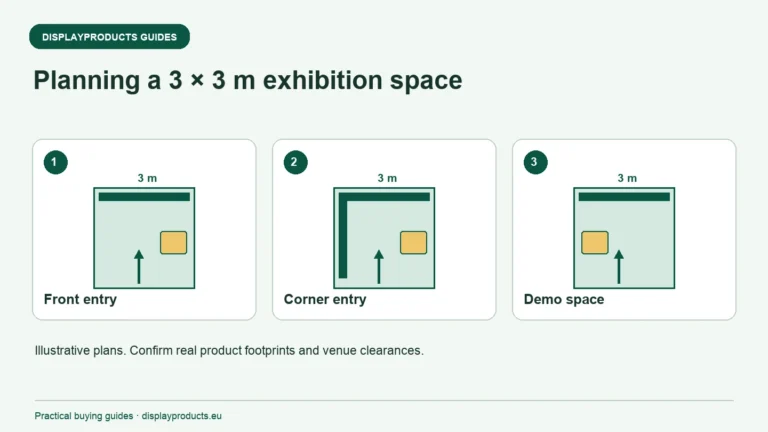
Layout di stand fieristici 3x3 per piccoli team
Uno stand espositivo di 3 × 3 m offre nove metri quadrati, ma lo spazio utilizzabile dipende dai lati aperti, dalla profondità dei piedini espositivi e dalle attività che si desidera ospitare.
Leggi la guida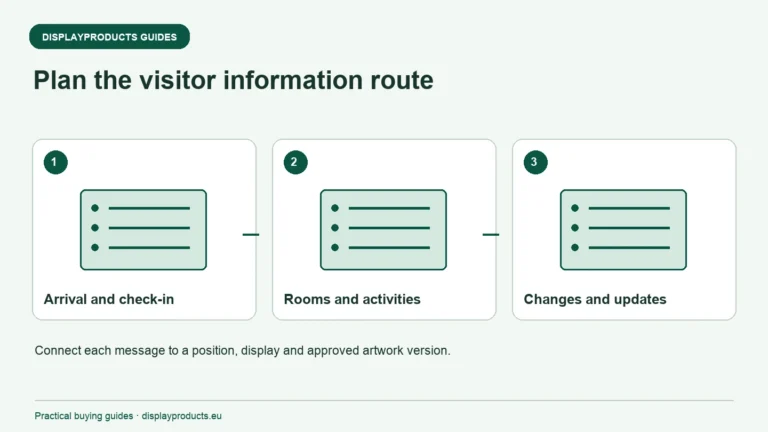
Lista di controllo per l'immagine coordinata dell'evento: ingressi, display e segnaletica.
Pianifica il branding dell'evento in base al percorso del visitatore: trovare la sede, riconoscere l'ingresso, effettuare il check-in, individuare l'area desiderata e capire cosa fare in seguito. Assegna a ogni elemento espositivo un messaggio e una posizione lungo tale percorso.
Leggi la guida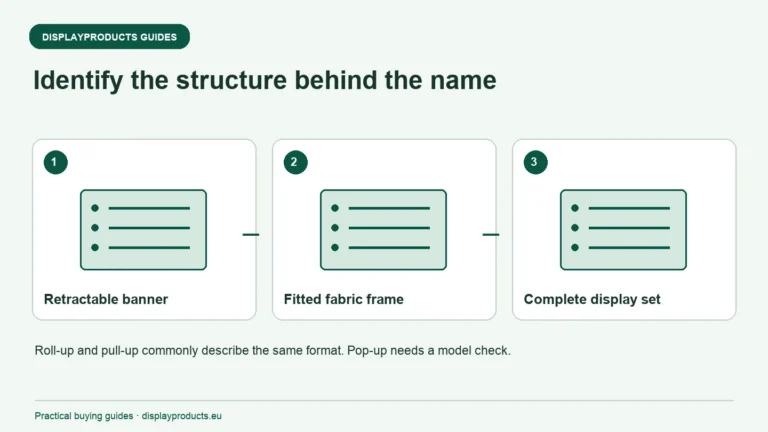
Striscioni Pop-Up vs Pull-Up vs Roll-Up
I termini "pull-up" e "roll-up" si riferiscono generalmente allo stesso formato di banner retrattile: la grafica stampata viene sollevata da una base e sostenuta da un'asta. Il termine "pop-up" è meno preciso e può essere usato in senso lato per indicare un banner portatile o un altro tipo di espositore con struttura a telaio.
Leggi la guida
Tendenze di mercato da valutare prima della prossima campagna
Quando si analizzano le tendenze in fatto di allestimenti, è importante chiedersi se una determinata funzionalità proposta sia effettivamente utile per l'evento o la campagna di vendita al dettaglio. Grafiche intercambiabili, layout adattabili, tessuti illuminati e collegamenti a contenuti digitali possono rivelarsi tutti elementi vantaggiosi.
Leggi la guida
Idee per uno stand fieristico chiaro e funzionale
Rendete utile uno stand fieristico assegnando una funzione precisa a ogni elemento espositivo e attività. L'immagine principale dovrebbe illustrare l'offerta, la disposizione degli spazi dovrebbe facilitare l'avvicinamento dei visitatori e il punto di interazione dovrebbe favorire la conversazione.
Leggi la guida
Come scegliere il display giusto per la tua attività
Scegliete un espositore in base alla funzione che deve svolgere, al luogo in cui verrà collocato e al modo in cui verrà utilizzato. Partite dal messaggio e dallo spazio disponibile, quindi confrontate la struttura, la grafica, la maneggevolezza e i requisiti di installazione nel loro insieme.
Leggi la guida